

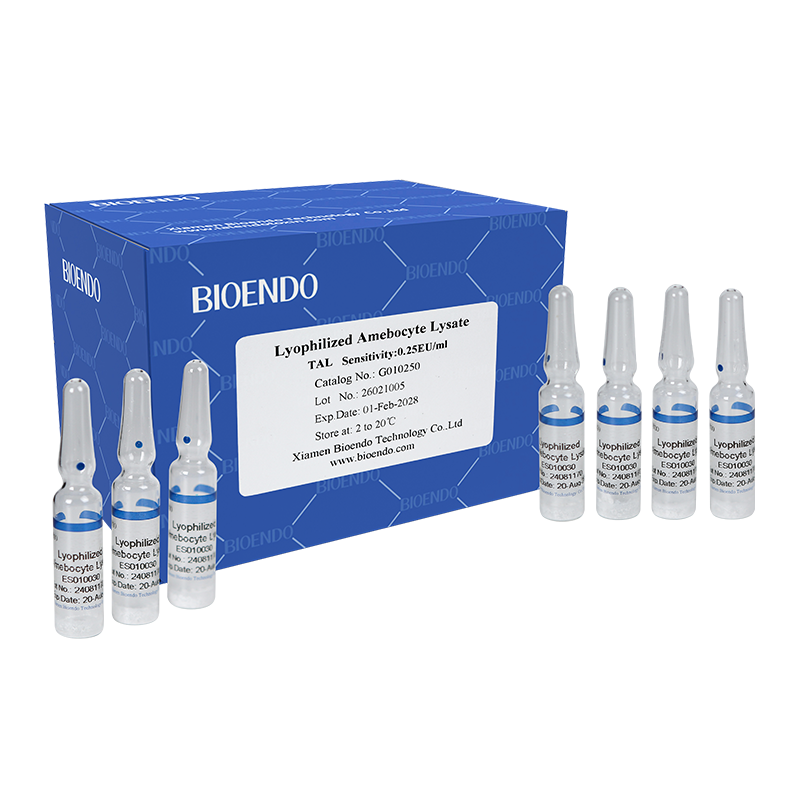
Gel Clot Method – This method detects bacterial endotoxins qualitatively or semi-quantitatively based on the principle of a coagulation reaction between the Limulus Amebocyte Lysate (LAL) reagent and endotoxins. Our uniquely formulated gel clot LAL reagent offers strong anti-interference capability and does not cause allergic reactions. It features high clarity, firm gel formation, and a broad sensitivity range.
| Catalog No. | Description & Kit Contents | Sensitivity Range |
| G010030 | 0.1 mL/ampoule(Single Test), 10 ampoules/box | 0.03 EU/mL |
| G010060 | 0.1 mL/ampoule(Single Test), 10 ampoules/box | 0.06 EU/mL |
| G010125 | 0.1 mL/ampoule(Single Test), 10 ampoules/box | 0.125 EU/mL |
| G010250 | 0.1 mL/ampoule(Single Test), 10 ampoules/box | 0.25 EU/mL |
| G010500 | 0.1 mL/ampoule(Single Test), 10 ampoules/box | 0.5 EU/mL |
The sensitivity of Lyophilized Amebocyte Lysate and potency of Control Standard Endotoxin are assayed against USP Reference Standard Endotoxin. The Lyophilized Amebocyte Lysate reagent kits come with product instruction, Certificate of Analysis, MSDS.
Note: For other sizes/specifications not listed above, please contact our customer service team.
Email: Eve@bioendo.com
Tel: +86 18065928551
TECHNICAL SUPPORT
Gel-Clot LAL Reagent Troubleshooting Guide
A practical guide to sensitivity verification, gel-clot result interpretation, sample interference testing, and troubleshooting positive product control results.
GEL-CLOT METHOD
01
Abnormal Sensitivity Verification Results
Why Does the Positive Control Fail to Form a Gel Clot?
1
Check the Working Standard Preparation
Ensure that the bacterial endotoxin working standard is prepared and serially diluted correctly. Vortex-mix thoroughly after each dilution step. Refer to the instructions for use (IFU) of the Bacterial Endotoxin Working Standard for detailed guidance.
Verify that the endotoxin concentration is appropriate for the sensitivity of the LAL reagent being used.
Verify that the endotoxin concentration is appropriate for the sensitivity of the LAL reagent being used.
2
Check the Incubation Conditions
A water bath or dry-block incubator is recommended for incubating gel-clot reaction tubes. Conventional incubators and ovens may not provide suitable conditions for the assay.
Important: Keep the reaction tubes undisturbed during incubation. Avoid vibration or movement. For circulating water baths, follow the validated procedure and instrument instructions to prevent circulation-induced disturbance.
3
Check the Result Interpretation Procedure
Carefully remove the reaction tube or ampoule from the incubator and slowly invert it 180°.
✓ Positive (+)
A firm gel clot forms and remains intact without deforming or slipping down the tube wall.
✕ Negative (−)
No gel clot forms, or a clot forms but fails to remain intact and slips down the tube wall.
02
How to Perform Endotoxin Testing on Samples
Follow the recommended sequence below to verify reagent performance and evaluate sample suitability before routine testing.
01
Verify LAL Reagent Sensitivity
Perform the endotoxin sensitivity verification test before testing samples.
02
Conduct a Preliminary Interference Test
Evaluate whether the sample may inhibit or enhance the gel-clot reaction.
03
Perform a Complete Interference Test
Confirm sample suitability under the selected test conditions.
04
Conduct the Endotoxin Limit Test
Test the sample against the applicable endotoxin limit using the validated test procedure.
03
PPC Fails to Form a Gel Clot
If the positive product control (PPC) fails to form a gel clot during sample testing, sample-related inhibition may be responsible. Verify the test system before determining the cause.
TROUBLESHOOTING STEP 01
Verify the Test System
Repeat the verification test using Water for Bacterial Endotoxins Test (BET Water) to check whether the reagent, testing procedure, personnel, and environment meet the applicable requirements.
TROUBLESHOOTING STEP 02
Evaluate the Verification Results
If the verification test meets the acceptance criteria, investigate whether sample-related inhibition is preventing gel-clot formation in the PPC.
TROUBLESHOOTING STEP 03
Apply Appropriate Sample Treatment
Dilution is one commonly used approach to reduce sample interference. Select a suitable dilution within the maximum valid dilution (MVD), where applicable, and repeat the interference test to confirm sample suitability.
!
Important Technical Note
Sample treatment and dilution conditions should be established through appropriate interference testing. Always follow applicable pharmacopoeial requirements, validated laboratory procedures, and the LAL reagent IFU.
TECHNICAL REFERENCE
This guide provides general troubleshooting information. Always consult the applicable pharmacopoeia, product instructions for use, and validated laboratory procedures when performing bacterial endotoxin testing.
RELATED EQUIPMENT
Compatible Endotoxin Detection Systems
Compatible instruments support different endotoxin detection workflows, from routine laboratory testing to fully automated analysis.
PRODUCT
DESCRIPTION
Full Wavelength Absorption Light Bacterial Endotoxin Detector
Fluorescent Endotoxin Detection Instrument
Multifunctional Endotoxin Detector
Bacterial Endotoxin Detector
Intelligent Fully-Automatic Endotoxin Detection System
Phoenix Q9
Intelligent Fully-Automatic Endotoxin Detection System
Modular Intelligent Fully-Automatic Endotoxin Detection System
Click the product name to view product details.