

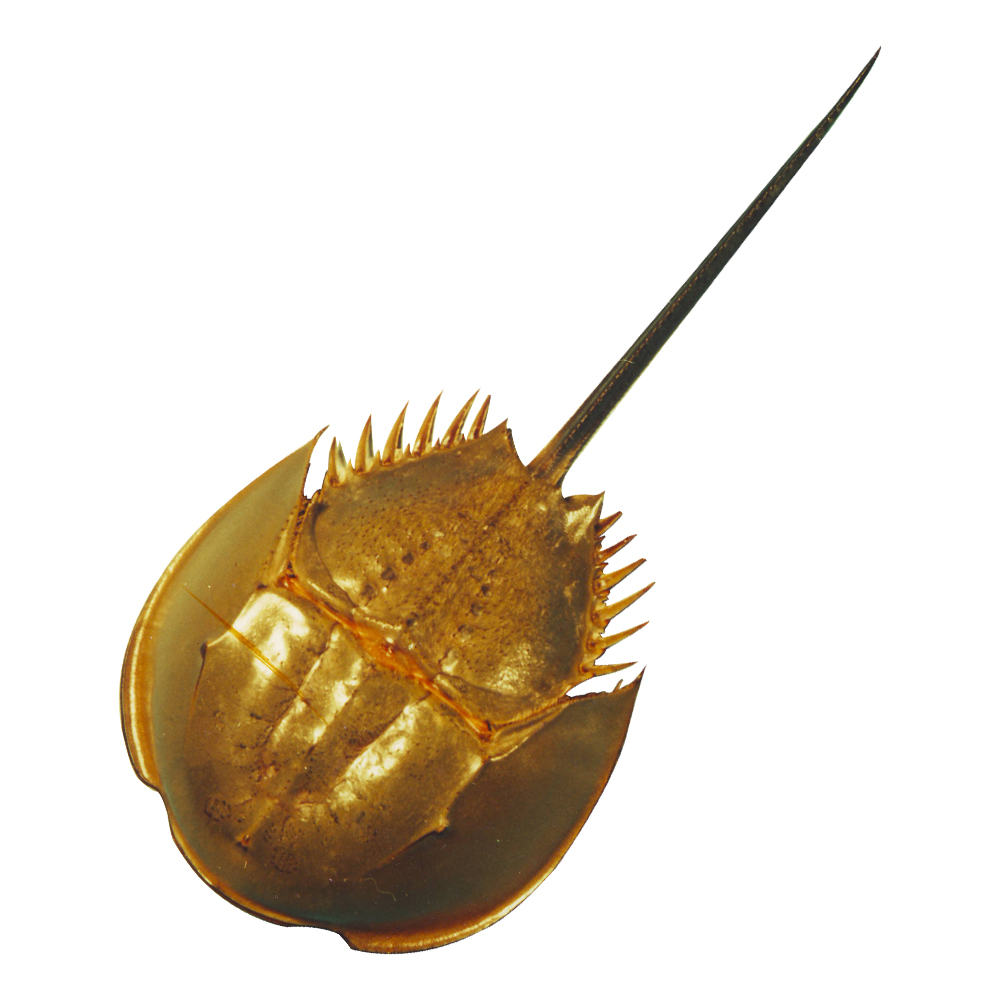
The horseshoe crab looks somewhat like both a shrimp and a crab, which is why it is commonly known as the “horseshoe crab.” It is an ancient animal, as old as the trilobite, which survives today only as a fossil.
The ancestors of horseshoe crabs appeared during the Devonian Period of the Paleozoic Era, when dinosaurs had not yet emerged and primitive fish had only just appeared. Over the course of time, animals that lived alongside the horseshoe crab either evolved or became extinct. The horseshoe crab, however, has survived for more than 400 million years while retaining its primitive and ancient appearance. For this reason, it is known as a “living fossil.”
During the breeding season in spring and summer, once male and female horseshoe crabs pair up, they remain inseparable. The larger female often carries the much smaller male on her back as they move slowly along the seafloor. When a pair is caught, both are usually found together. For this reason, horseshoe crabs are affectionately known as the “lovebirds of the sea.”
Horseshoe crabs have four eyes. At the front of the prosoma are two small eyes, each approximately 0.5 mm in size. These small eyes are particularly sensitive to ultraviolet light and are believed to be mainly responsible for detecting brightness. On both sides of the prosoma is a pair of large compound eyes, each composed of numerous smaller visual units. Scientists have discovered that the compound eyes of horseshoe crabs exhibit a phenomenon known as lateral inhibition, which enhances the clarity of images. This principle has been applied to television and radar systems to improve image clarity and radar display sensitivity. As a result, this ancient animal, which had remained relatively unknown for millions of years, has become a remarkable “star” of modern biomimetics.
Horseshoe Crab Blood and LAL
Horseshoe crab blood contains copper ions, giving it a distinctive blue color. An extract of this blue blood, known as Limulus Amebocyte Lysate (LAL), can be used to rapidly and accurately detect bacterial endotoxin contamination. It is widely used in the pharmaceutical and food industries for monitoring endotoxin contamination.
In addition, the meat and eggs of horseshoe crabs are edible.